
UI, UX and service design
Effective design for systems with complex processes.
What you get
Design decides whether a line-of-business system gets used or worked around.
- Fewer wrong clicks in complex processes — the screens follow the workflow, not the data model.
- A prototype you can test before coding starts — changes cost minutes instead of weeks.
- WCAG requirements covered — contrast, keyboard navigation and a logical structure from the first sketch.
- One supplier for design and development — designer and developer sit in the same team throughout the project.
Proof: Kulturtanken got a portal and case system serving many user groups. Kartverket got a digital field tool, and Kolumbus an app used daily by travellers.
Customers we have done this for: Kulturtanken Kartverket Kolumbus
Development is more than code and functionality
Software development is about more than code and functionality. How people actually work in the system matters just as much: the flow, the sequence, the overview and how easy it is to find information. For digital work tools and line-of-business systems, the main goal is a system that is logical, clear and efficient to use.
User experience (UX) therefore plays an important role. A well-considered interface helps people complete tasks faster, reduces the risk of errors and makes the system easier to adopt.
How do we work with design?
From idea to prototype – fast and tangible
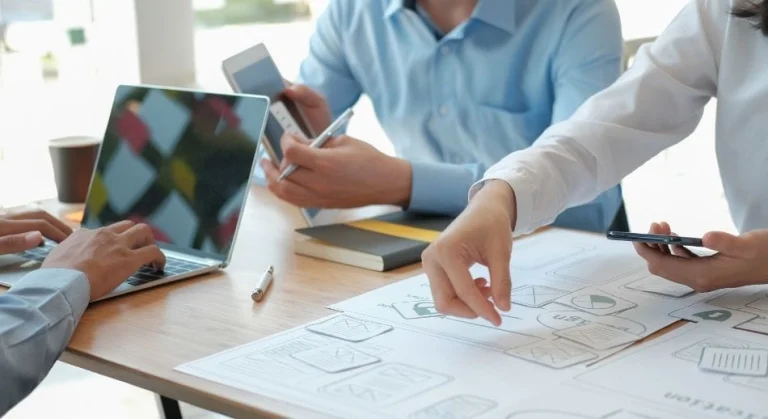
In most projects we work closely with the customer. The design takes shape through dialogue, and the customer gets to see and test prototypes early. That lets us adjust as we go and quickly validate ideas against the real work processes. We always take account of the internal and statutory requirements that govern how a process must be carried out. At the same time we keep the design work concrete and efficient: instead of lengthy analysis we get straight to the point, sketch out the workflows and refine them together with the users.
Deeper insight when the project calls for it
When a project requires it, we can add more extensive research such as interviews, observation, workshops or user testing. This is particularly relevant for software with several different user groups, or where the system supports collaboration between multiple parties, such as customers and suppliers.
Service design – the whole picture across user groups
In some projects we lift our gaze further and look at the entire service in a broader perspective. Service design is about understanding how a solution is experienced across different touchpoints, both digital and physical, and how the interplay between internal and external parties can work as well as possible. Here we work on the whole: how processes, systems and user groups fit together in one coherent service journey.
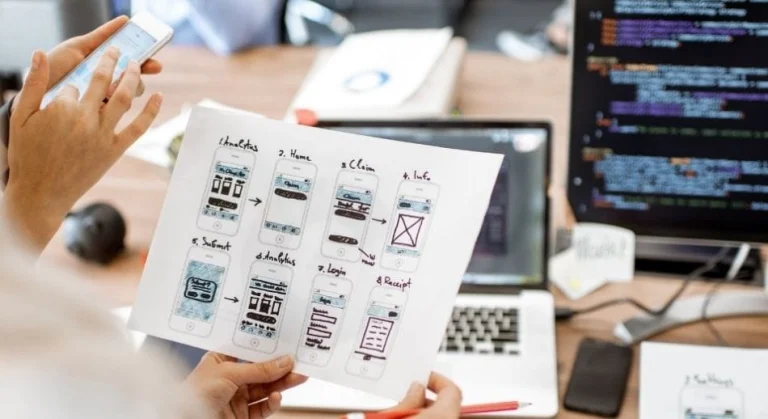
In projects like these we carry out a larger mapping exercise, often with interviews, site visits, observation and workshops. We look at how the different user groups work today, what challenges they meet, and how the system can simplify and streamline work processes across the organisation. The result is usually user journeys, process maps and prototypes that give a clear overview and make it easier to identify bottlenecks and opportunities for improvement.
This approach can be especially valuable for software developed for an entire sector or industry, where many organisations and user groups are to be brought together in one shared solution. Then it becomes essential to look at the whole picture and make sure the system works for every party throughout the service journey.
What do UI, UX and service design actually mean?
What is UI?
How the system looks – from buttons and menus to colours and layout.
What is UX?
The experience of using the system, and how efficiently and logically tasks can be completed.
What is service design?
A holistic view of digital or physical services, where you map the needs of different users and develop solutions that work well for everyone.
Designers and developers working together
With us, designers and developers are part of the same team and work side by side throughout the project. That means we do not just hand over static sketches – we follow the design all the way from prototype to finished solution.
The designer takes an active part in the development work, tests functionality against sketches and usage scenarios, and gives feedback continuously. This way of working makes sure solutions are actually built as planned, and that adjustments can be made quickly along the way.
For the customer this means a more efficient process and fewer misunderstandings. That close collaboration is one of our strengths, and an important reason why many choose us over two separate suppliers delivering design and development in isolation.
Key design principles
Our design work follows a set of basic principles and requirements. They make sure our solutions are of high quality, work well across devices and meet both user needs and current standards.
Responsive design matched to real use
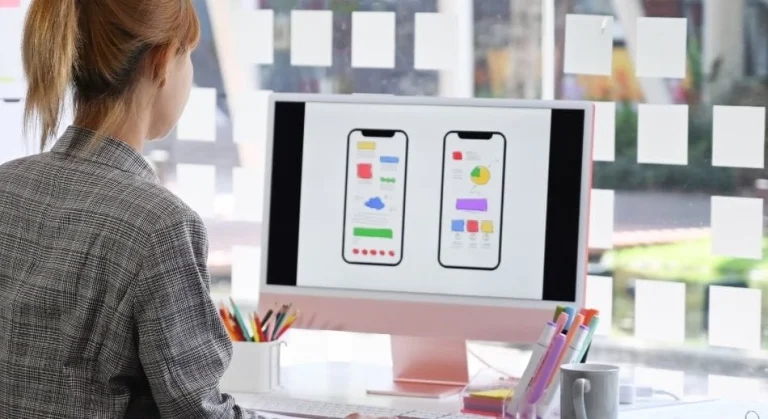
We always develop with different screen sizes in mind. At the same time we consider how the solution is actually used in practice. Many of our systems are used mainly on desktop computers, where complex processes need a larger working area. Others are used in the field or on mobile devices, and there we design interfaces and workflows that work just as well on tablet and mobile.
By analysing real use and matching responsive design to actual needs, we make sure the systems are both functional and easy to use – whatever the device.
Accessibility and WCAG
We put weight on universal design and follow the WCAG guidelines (Web Content Accessibility Guidelines). Even though many of the systems we build are internal and used by trained employees, accessibility still matters.
Good accessibility is not only about meeting legal requirements – it also makes systems more robust and easier for everyone to use. We prioritise principles such as clear contrast, logical navigation, standardised components and support for keyboard navigation.
Google Material Design
We base our UI design on Google Material Design (m3.material.io), which gives a modern, familiar and consistent interface. Using established guidelines and ready-made components lets us develop faster, maintain high quality and give users an experience that feels intuitive and recognisable across solutions.
Visual identity and graphic design
Alongside our UI and UX expertise, we also have strong experience in graphic design. We can either work from existing brand guidelines or develop a new visual identity for the service. That covers everything from colours and typography to the graphic elements that build a coherent identity.
Good graphic design strengthens the brand, and it matters especially in projects where the organisation’s own customers are the end users of the solution. We make sure the design not only works technically, but also comes across as professional and appealing – in short, that it looks good.
Why Netpower WEB Solutions?
One team in Stavanger that takes you from idea to live operation – and is still there after launch.
You own the code and the data
No licence lock-in and no hostage-taking. You are free to adapt the solution, take it with you or change supplier.
The same team from design to operations
The people who design and build the solution are the same ones who maintain and develop it afterwards.
Hosting in Norway if you want it
The solution can run in Netpower’s own data centre in Stavanger, so your data stays in Norway.
People you can phone by name
You get a named contact in Stavanger, not a ticket number in a queue.
Our development and software services:
Bespoke development
Further development
Mobile development
Integrations
DevTeam for hire
UI/UX and service design
SharePoint and Microsoft 365
Mobility solutions
E-commerce
Also in Netpower IT Group:
Netpower Business Solutions – ready-made systems: Certain QMS, Workplace Safety and ChemCenter. See the products →
Netpower IT Solutions – hosting and 24/7 operations in our own data centre in Stavanger. See operations and cloud →